The Pink Stuff in Your Shower Isn’t Actually Mold

Updated: Sep 28
What homeowners should know about that pink or reddish buildup—and why it keeps coming back.
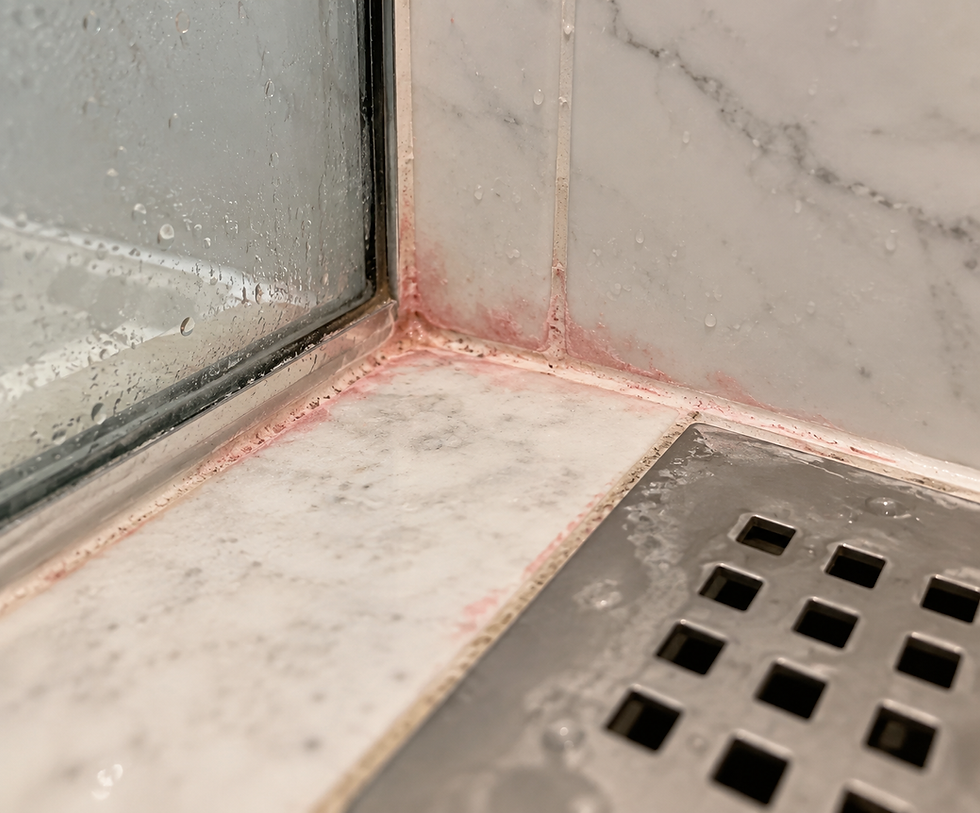
If you’ve ever noticed a pink, peach, or reddish film forming around your shower drain, along grout lines, near the bottom of a shower curtain, or in other constantly damp areas, you’re definitely not alone.
It’s commonly called “pink mold,” but in many cases, it isn’t mold at all.
One organism commonly associated with this type of buildup is Serratia marcescens, a bacterium that can produce a pink-to-reddish pigment.
And while cleaning away what you can see may make your shower look better, understanding why it keeps appearing is the key to keeping it under control.
Why Does It Show Up in the Shower?
Bathrooms create a pretty ideal environment for recurring buildup: moisture, warmth, limited airflow, and surfaces that stay damp.
Residue from things like soap and personal-care products can also accumulate on shower surfaces. Combine that with persistent moisture, and you have an environment where microorganisms and biofilm can establish themselves.
That’s why you may notice the pink discoloration returning in the same places again and again—especially around drains, grout, corners, caulking, and areas where water tends to sit.
Is Pink Mold Dangerous?
For most healthy people, seeing pink buildup in a shower isn’t a reason to panic. However, Serratia marcescens is an opportunistic pathogen and has been associated with infections, particularly in healthcare settings and in people who are medically vulnerable.
That’s one reason we recommend treating recurring pink buildup as more than just a cosmetic issue.
And importantly, you can’t reliably identify a microorganism by color alone. Not every pink or reddish stain in a bathroom can be confirmed as Serratia marcescens simply by looking at it.
Why Does It Keep Coming Back?
This is where homeowners often get frustrated.
You clean the shower. The pink disappears. A week or two later…it’s back.
The visible discoloration is only part of the equation. If the conditions that encourage buildup remain—constant moisture, poor ventilation, standing water, and residue on surfaces—you may continue seeing it return.
Prevention isn't just about using a stronger cleaner.
It’s about changing the environment.
What Can You Do About It?
Keeping shower surfaces cleaner and drier between uses can make a significant difference.
Run your bathroom exhaust fan during and after showering, allow the shower to dry as thoroughly as possible, regularly clean areas where water and residue collect, and address any ventilation or persistent-moisture issues.
Pay particular attention to grout lines, shower-door tracks, drains, corners, caulking, and other areas that don't dry quickly.
One important note: more aggressive does not always mean better.
Natural stone, specialty finishes, certain metals, grout, and other bathroom materials can be damaged by inappropriate products or overly aggressive scrubbing. Always choose a cleaning method that's compatible with the surface you're treating.
The Bigger Lesson: Your Shower Is an Environment
This is exactly why we believe home care should go beyond making something look clean.
A shower can look beautiful immediately after cleaning, but understanding the materials, moisture, ventilation, buildup, and recurring problem areas is what helps you care for it properly over time.
At Crystal Shine, we pay attention to those details because preserving a home starts with understanding it.
Know your home. Protect your investment.
The Crystal Shine Journal
Sources & Further Reading
U.S. Environmental Protection Agency (EPA) — A Brief Guide to Mold, Moisture and Your Home Information about moisture control, bathroom ventilation, and preventing microbial growth in damp indoor environments.
Centers for Disease Control and Prevention (CDC) — Healthcare-associated infection resources and information regarding opportunistic pathogens.
National Library of Medicine / PubMed — Scientific literature regarding Serratia marcescens, its characteristic pigment, environmental presence, and role as an opportunistic pathogen.
American Society for Microbiology (ASM) — Educational microbiology resources regarding Serratia marcescens and microbial growth.
Comments